
Connect AI Agents to Enterprise Applications
MCP enables AI agents to access data and functionality within enterprise applications in a controlled way and perform tasks in the context of business processes.
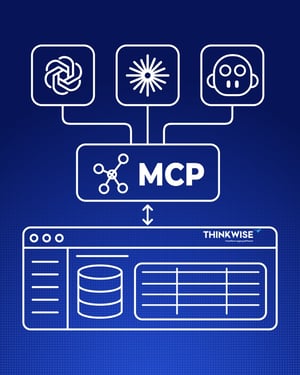
With the Model Context Protocol (MCP), the Thinkwise Platform supports an open standard that enables AI agents to interact with enterprise applications. MCP-compatible AI systems can access approved data and functionality within a Thinkwise application and use them as tools.
Importantly, AI agents operate within the existing security and authorization framework of the Thinkwise Platform.
Let AI agents retrieve information from your enterprise applications without having to navigate through multiple screens yourself.
Let AI agents analyze available business data and use it to generate insights and reports.
Let AI agents perform authorized actions within your business processes, while maintaining control and visibility.
MCP enables two key use cases within the Thinkwise Platform.
AI works with your application
Within existing access permissions, AI agents can retrieve information, analyze business data and execute actions in your Thinkwise applications. This brings AI directly into your daily business processes, allowing users to complete tasks without having to navigate through multiple screens and systems themselves.
AI works on your application
Through MCP, AI tools can interact directly with the Thinkwise Software Factory. Based on a description, developers can use AI to create new application components or modify existing functionality.
This shifts the focus from manual modeling and programming toward describing, reviewing and refining applications.
With MCP, Indicium, the runtime component of the Thinkwise Platform, can act as an MCP server. This allows MCP-compatible AI applications to access approved data and functionality from applications running on the Thinkwise Platform.
The Thinkwise application remains the system of record for data, business logic and access permissions.
Technical Foundation
- Standardized MCP endpoint via Indicium
- OAuth-based authentication
- Role-based access delegation through the Thinkwise Intelligent Application Manager (IAM)
- Integration with MCP-compatible AI systems
For business-critical applications, it is essential to define exactly which data and actions an AI agent is allowed to access.
That is why Thinkwise integrates MCP into the platform's existing user, role and authorization structure. Administrators and users authorize AI access according to their respective roles. AI agents can only access the data and functionality they are authorized to use.
Changes to data made by AI agents are explicitly logged, ensuring that AI-driven actions remain transparent and traceable.
What matters is what powers it.
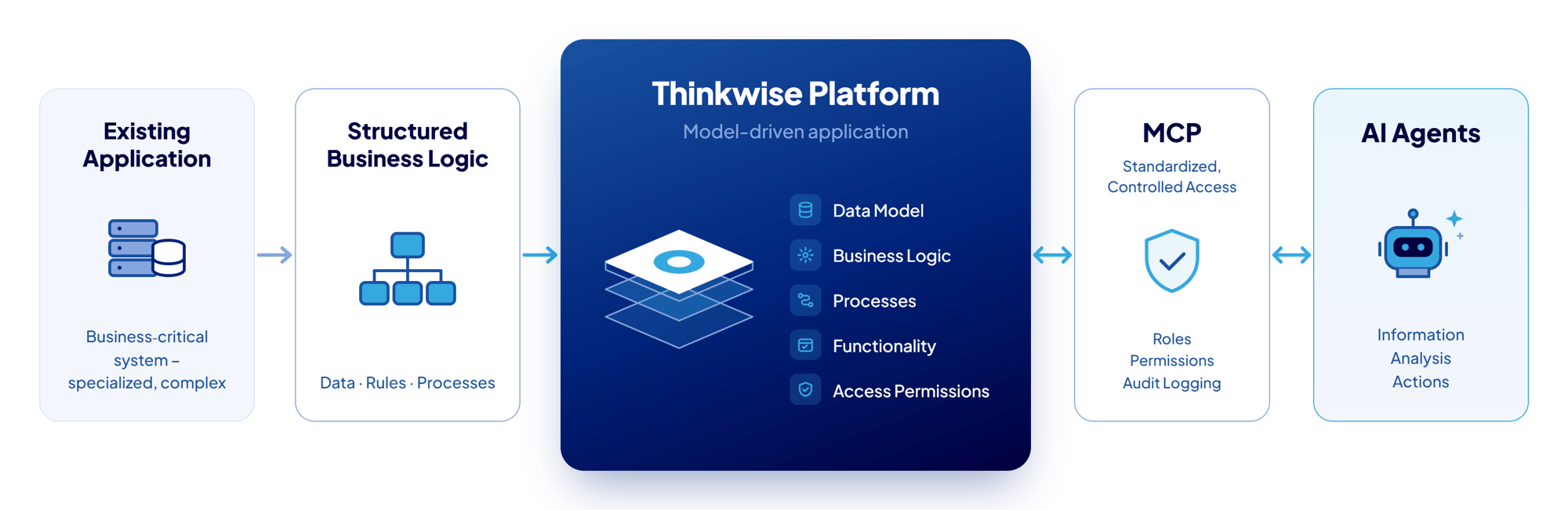
MCP standardizes the connection to AI agents. But ultimately, the real value lies in the data, business logic and functionality made available through that connection.
At Thinkwise, applications are built on a centralized application model that captures data structures, business logic, processes, functionality and access permissions in a structured way. This allows AI agents to interact with predefined functionality within a controlled enterprise application.
The model-driven architecture provides the foundation for making functionality available to AI agents in a controlled way, based on structured business logic, processes and data models.
This creates a modern, AI-native enterprise architecture in which business logic, data and processes are structured and accessible to AI agents and intelligent automation.
Modernization gives organizations the opportunity not only to upgrade their existing enterprise software, but also to prepare it for AI agents.
Many existing business-critical applications contain valuable business logic but are technically difficult to access through modern AI applications and AI agents.
With the Thinkwise AI Upcycler, existing data structures and business logic can be analyzed and transformed into a modern application model on the Thinkwise Platform.
Modernization therefore also creates opportunities to make existing business logic available in a structured way for AI, modern technologies and AI agents.
Watch the Thinkwise Summit sessions
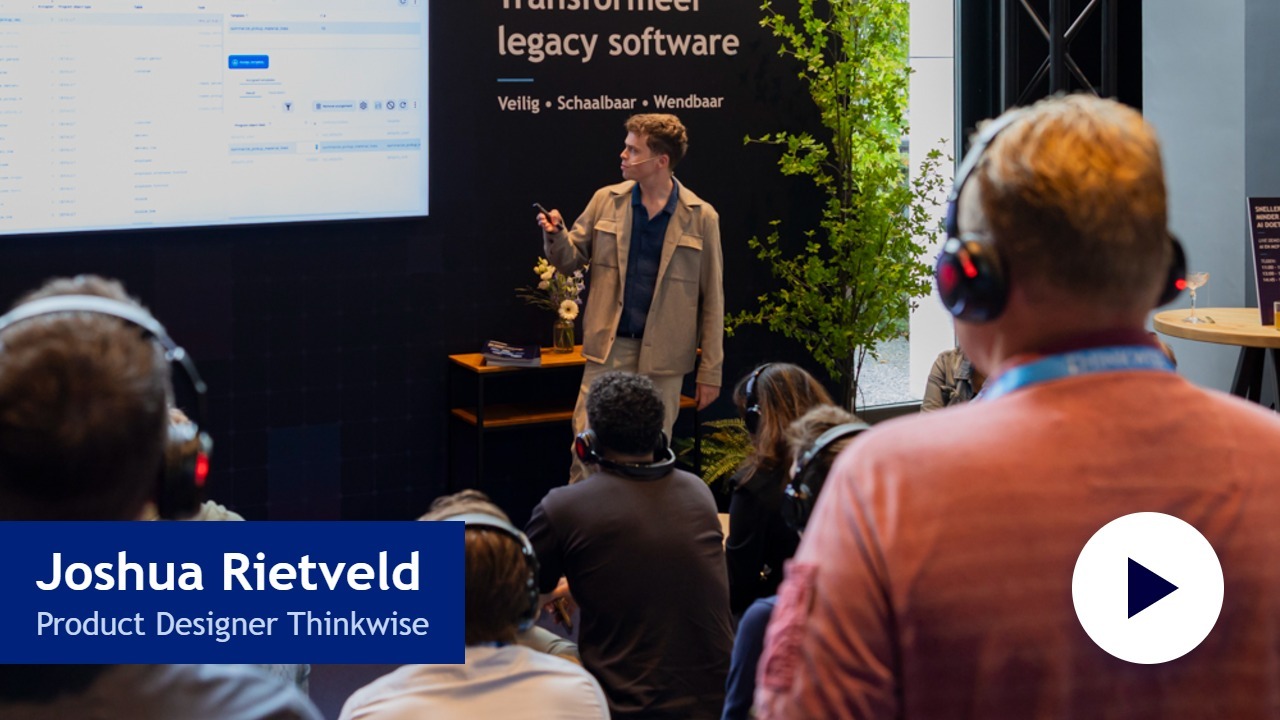
AI and MCP in the Software Factory
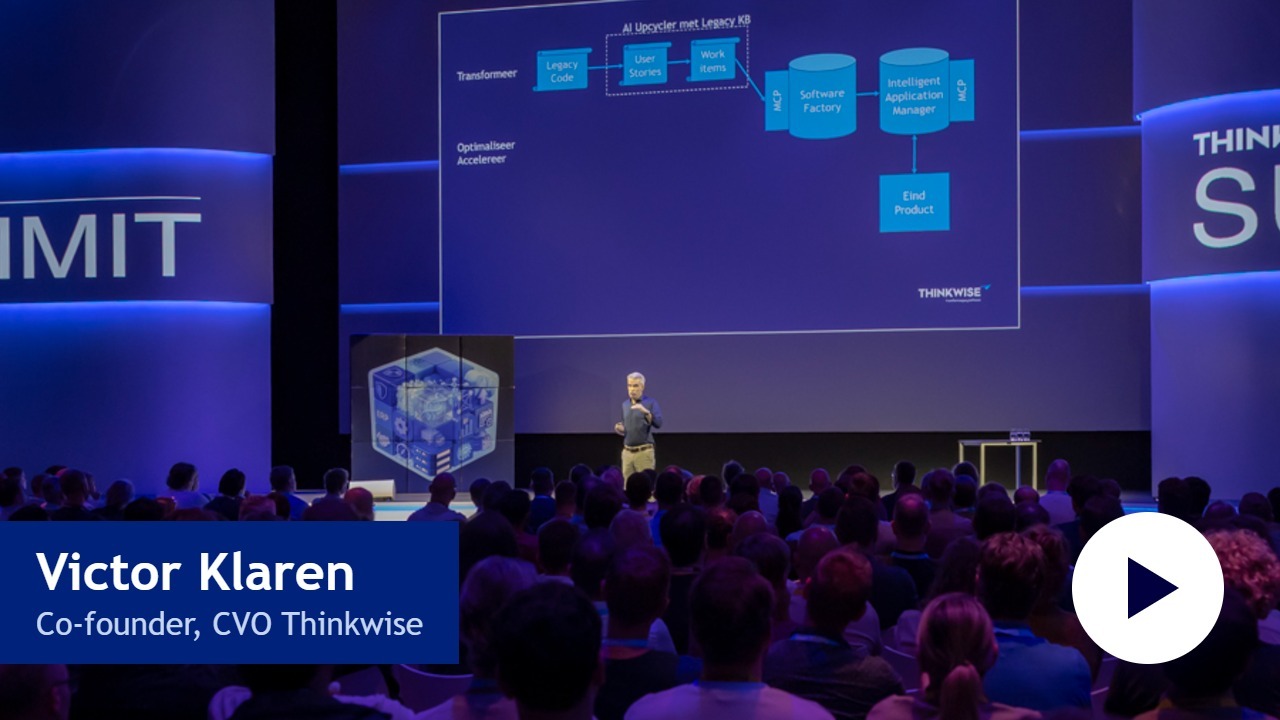
AI is changing enterprise software. Now it's your move.
Victor Klaren shares his vision for AI, modernization and the future of enterprise software.
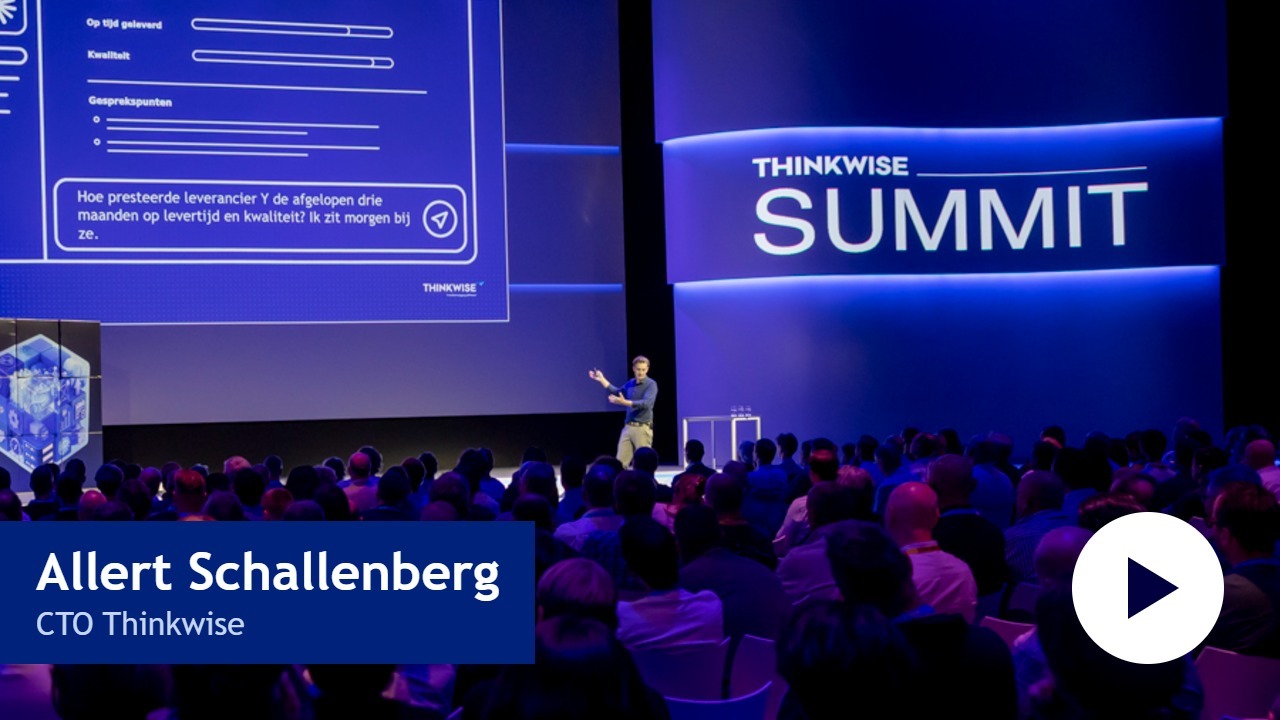
MCP: The strategic impact on organizations
Discover how AI agents can interact with enterprise applications and what this means for your organization.
The Model Context Protocol (MCP) is an open standard that enables AI agents to connect with external systems, data and functionality.
Instead of building separate integrations for each AI application, MCP provides a standardized way for AI agents to discover and use available tools. This allows AI to go beyond generating answers and interact with enterprise applications and business processes.
No. MCP complements existing APIs rather than replacing them.
APIs enable systems to exchange data and execute specific operations. MCP builds on these capabilities by providing a standardized way for AI agents to discover and use available functionality.
This makes it easier to connect AI applications to enterprise systems without developing a separate AI-specific integration for every use case.
The Thinkwise Platform supports MCP through Indicium, its runtime component, which can act as an MCP server.
This enables MCP-compatible AI applications to access approved data and functionality within Thinkwise applications. Existing business logic, roles and access permissions remain in place, ensuring that AI agents operate within the application's established security framework
No. AI agents can only access the data and functionality they are explicitly authorized to use.
Thinkwise integrates MCP with the platform's existing user, role and authorization structure. Access is controlled through established permissions, and changes made by AI agents are logged.
This ensures that AI-driven interactions remain controlled and traceable.
Thinkwise MCP can connect with AI applications and agents that support the Model Context Protocol.
This allows organizations to work with compatible AI solutions from different providers, rather than being tied to a single AI model or vendor.
The available integrations depend on the MCP capabilities and configuration of the AI system being used.
Agentic Model Engineering is an approach to software development in which AI agents work directly with the application model.
Through MCP, AI tools can interact with the Thinkwise Software Factory to help developers create new application components or modify existing functionality based on natural-language instructions.
Developers remain in control, reviewing and refining the results. This shifts their focus from manually building every component to defining requirements, validating outcomes and improving applications.
AI-native modernization goes beyond replacing outdated technology. It also prepares enterprise applications to work with modern AI capabilities.
With the Thinkwise AI-Upcycler, existing data structures and business logic can be transformed into a structured application model on the Thinkwise Platform.
MCP then provides a standardized way for AI agents to interact with approved data and functionality within these applications.
Modernization is not required to use MCP with existing Thinkwise applications, but it can help organizations make valuable business logic from legacy systems accessible to AI.
Thinkwise provides the foundation.