
For many organisations, the IBM i platform still forms the backbone of daily operations. These systems are stable, reliable, and often decades old. But beneath that dependable surface lies a growing threat, one that has little to do with technology itself. The number of people who truly understand these environments is rapidly shrinking.
Recent industry analyses paint a remarkably consistent picture. ASNA warned in late 2024 that the average RPG developer is now approaching retirement age, while IT Jungle described the situation in early 2025 as “one of the most critical skills gaps in Enterprise IT”.
Expertise that’s ageing out
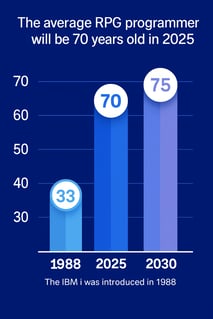 The demographic trend within RPG teams has been the same for years: most deep expertise sits with professionals in the final decade of their careers. IT Jungle notes that the most advanced RPG knowledge “is concentrated in a demographic that will largely leave the sector within ten years”.
New talent is almost non-existent. Dutch universities no longer teach traditional IBM languages, and young developers understandably gravitate toward cloud-native, API-driven, and data-centric technologies.
This leaves organisations in an uncomfortable position: the applications remain mission-critical, yet the number of people who understand their logic, exceptions, and historical decisions declines further every year.
A stabilising labour market, but a shrinking niche
The wider Dutch IT labour market is expected to stabilise in 2025. But that cooling trend barely affects highly specialised segments. According to the Dutch Employee Insurance Agency (UWV), roles requiring niche languages or platform knowledge remain structurally tight. RPG falls squarely into this category.
Outflow is high. Inflow is minimal. Replacement is difficult, even with above-market salaries.
For teams dependent on RPG expertise, a stabilising labour market changes little.
Business continuity exposed
In many organisations, the knowledge of core applications depends on one or two specialists. During audits, the “bus factor” is now a common topic: what happens if these people leave?
Gartner highlighted legacy expertise in late 2024 as “one of the top five operational risks” in custom-heavy IT environments. Not because IBM i is unreliable, but because business logic is often tightly intertwined with the work of long-serving developers.
At the same time, the technology itself is under pressure. RPG applications are frequently monolithic and historically grown, making integration with cloud services, data platforms, APIs, or AI increasingly difficult. Even with a full team of developers, organisations would struggle to keep these applications agile.
Innovation Slows Down
The impact on transformation programmes is clear. Minor changes that were once routine now rely on scarce expertise. Lead times increase. Impact analyses become less certain. Integrations with modern SaaS platforms require disproportionate effort.
Automation projects are postponed simply because no one can confidently assess which logic will be affected.
Hexaware previously concluded that organisations relying on languages such as RPG are “disproportionately affected by talent gaps”, and pointed out that these languages “were never designed for modern digital transformation”. This makes ambitions around AI, analytics, integration, or real-time processes difficult to execute on today’s technical foundation.
Organisations start looking for alternatives
As RPG expertise continues to disappear, organisations are forced to choose a path forward. In practice, several scenarios emerge, each with its own constraints.
1. Training people in-house
Upskilling lateral hires or IT colleagues helps temporarily, but does not solve the structural outflow.
2. Manual modernisation or complete rebuild
Some organisations attempt to modernise RPG applications manually or opt for a full rebuild. These efforts often prove lengthy, costly, and more complex than anticipated. Largely because original business logic is difficult to replicate.
3. Migrating to standard software
Switching to ERP or industry packages is frequently considered. But many RPG systems contain decades of refined customisation that simply doesn’t fit into standard software, leading to functional loss.
A New Alternative: AI-Driven Modernisation
A fourth option is emerging: automatic modernisation powered by AI.
With this approach, existing RPG applications are automatically converted into a modern application structure within the Thinkwise Platform. This fundamentally differs from manual modernisation or rebuilds, because entire applications can be analysed, interpreted, and translated at once — including business logic, data structures, and screen behaviour.
Thinkwise has developed an AI-Upcycler that performs this translation automatically, without rebuilding the application from scratch. This new AI capability is an advanced evolution of Thinkwise’s proven Upcycler technology, making it possible to interpret complete RPG code bases and convert them into a modern model.
The result: a practical alternative to long rebuild projects, with full preservation of business logic.
Want to learn more about automatic RPG modernisation?
